
State of the Basin Report 2026

A Guide to the
Colorado River Crisis

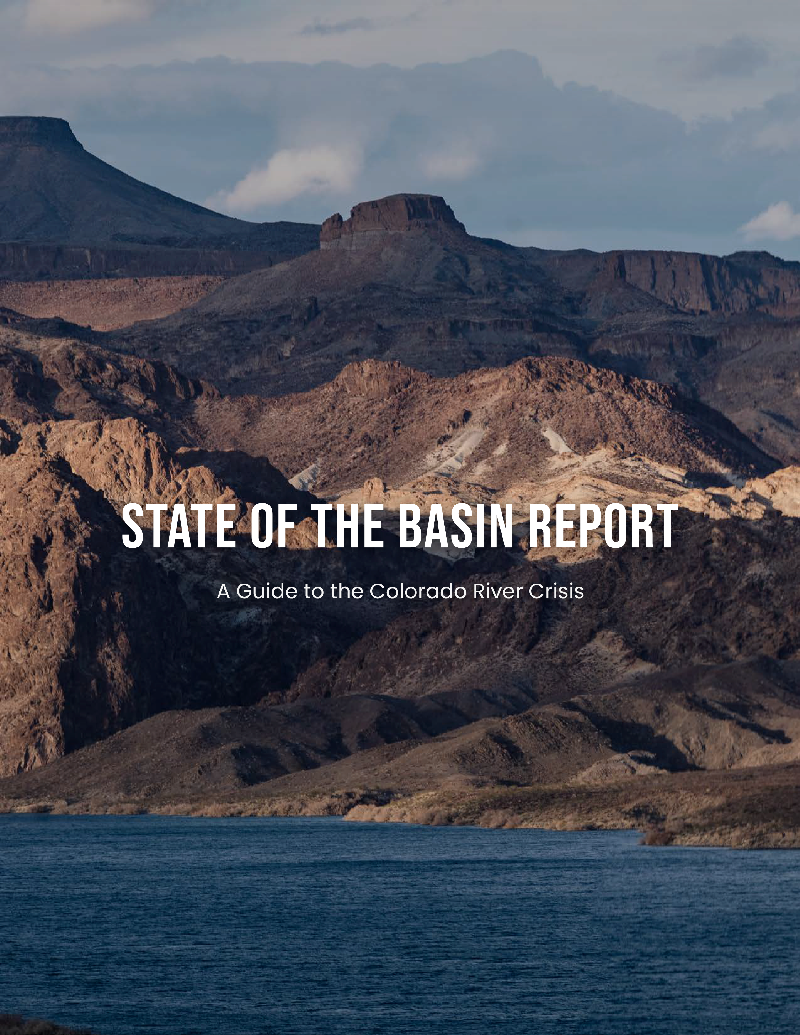
The State of the Basin Report is the first comprehensive synthesis of the intensifying drought, governance challenges and potential solutions to the Colorado River’s worsening water crisis, which is impacting 40 million people and more than $1.4 trillion in annual GDP.

A watershed moment for the Colorado River

Released in conjunction with the “Keep the River Running” campaign, the report comes with the Colorado at a crossroads: the river’s flow is severely reduced and reservoirs at record lows.

It is time for the Colorado River Basin to pivot from crisis management to building long-term solutions for this lifeline of the American West.

Drawing on recent research, the report highlights the scale of the shared challenges as well as the very real opportunities to accelerate action to safeguard the river and all the communities and economies that depend on it.

Explore the report

Browse the findings, challenges, potential solutions and supporting resources from the State of the Basin Report, which highlights:
  • The current hydrological and ecological state of the Colorado River Basin, including challenges with historically low snowpack, record low inflows, and growing salinity.
  • Key system pressures including water security, governance, economic risk and climate adaptation.
  • Shared challenges affecting agriculture, cities, energy, ecosystems and Tribal communities across the Basin.
  • High-impact intervention areas and opportunities that can be scaled up to strengthen long-term Colorado River Basin resilience.

Key Resources

Access the Executive Summary, shareable graphics and media materials.

Executive Summary

Key findings and recommendations at a glance.

Infographics and visual resources

Access data visualisations and shareable assets from the report.

Press Release

Official announcement and media materials.

A Guide to the Colorado River Crisis in 8 Stories

Mina Guli’s epic journey down the Colorado River isn’t about numbers on a page. It’s about witnessing the frontlines of a water crisis and raising the voices of the people living through it, including those coming up with creative solutions.

In this series of videos informed by the State of the Basin Report, Mina’s team brings the reality of the river basin to life, from declining snowpack and river flows to new approaches in agriculture, water management and restoration.

The Colorado River Needs Solutions Like This | Agrivoltaics Explained

Back in the early days of Mina’s run, we met someone who changed the way we think about water and farming.

Byron Kominek turned his Grandpa Jack’s struggling family farm into a site with more than 3,000 solar panels generating enough power to support hundreds of homes.

But the panels aren’t the point. What’s growing underneath them is.

Jack’s Solar Garden is researching agrivoltaics – adding raised solar panels to agricultural fields. The shade helps keep plants cooler and saves water, while moisture from the plants helps keep the panels cool, helping them produce more energy.

It’s one of those rare win-wins identified in our State of the Basin Report.

Standing under those panels, seeing the plants green the fields, I felt so much hope for the future of the Colorado River Basin. From the parched landscape of the Grand Canyon where I’ve been running through gruelling heat, it feels even more like a dream.

Beaver Dam Analogues: Learning from Nature’s Engineers

What if one of the simplest ways to make our rivers more resilient is… beavers?

Beaver Dam Analogs (BDAs) are surprisingly simple, low-cost structures designed to mimic the work of beavers. They slow water down and spread it across the landscape, helping it soak into the ground instead of rushing downstream.

That can help wetlands regenerate, bringing back plant life that holds soil, filters water and cools the surrounding air.

The added moisture can also make the landscape more resilient to wildfire.

And then something pretty incredible can happen: real beavers move back in and take over the work themselves.

Across the Colorado River Basin, communities, researchers, Tribes and government agencies are already putting BDAs to work, showing what can happen when we work with nature, rather than against it.

Sometimes the best solution is the one nature already figured out. We just have to get out of the way and let it work!

How Denver Is Tackling Urban Water Conservation | Colorado River Solutions
Before Mina took her first steps along the Colorado River, we brought leaders together in Denver to talk about what it will take to build a more resilient future for the river.

Elizabeth Babcock, Executive Director of Denver’s Office of Climate Action, Sustainability and Resiliency, shared what that looks like in practice. Across Denver, thirsty, non-functional turf is being replaced with native, low-water vegetation, and the city is working with major commercial users to reduce their water use.

These are practical changes, but Elizabeth also spoke about what it takes to make solutions like these work at scale.Watch to see what water conservation and climate adaptation can look like at a city level.

How This Colorado Farmer Uses 25–30% Less Water
From the very start of this run, we wanted to understand how people along the Colorado River are adapting to growing water scarcity.

At Peachfork Vineyard, Phil Patton showed us how he’s cut the water he uses for irrigation by 25–30%, what it took to make that possible, and why having the right financial support can be just as important as the solution itself.

What Record-Low Snowpack Means for the Colorado River
Long before the Colorado reaches a farm, city or tap, its fate is being shaped in the Rocky Mountains. This year, the snowpack that replenishes the river fell to just 17% of normal, a historic record low. Brian Domonkos, Colorado Snow Survey Supervisor, explains what the numbers are telling us about the water 40 million people depend on.
How Farmers Are Using Technology to Save Water on the Colorado River

For three months, Mina ran the length of the Colorado River meeting people whose lives, work and futures depend on its water.

Grant and Calista Chaffin were two of the people who fundamentally changed what Mina thought was possible for the river.

Their farm is a brilliant example of how technology, investment and collaboration can help farmers use water differently while enabling communities and farms to thrive for generations to come.

Seeing what can happen when new ideas are backed by the right investment and partnerships is a beacon of hope for the future of the Colorado.

What Happens When the Colorado River Runs Too Low?

One of the things Mina kept coming back to during the run was how the demands on the Colorado River keep growing – as its flows and reservoir levels continue to fall.

It still has to support farms, communities, wildlife, recreation, businesses and ever growing cities. And when there isn’t enough water left in it, the consequences ripple through all of them.

Talking with Kate Ryan from the Colorado Water Trust and angler Stephanie Ridge made those consequences feel very real, while also showing us how people are working to keep more water in the river where it’s needed most.

Inside Southern Nevada’s Approach to Water Conservation

Running through Southern Nevada got us thinking about what it takes to build a city in one of the driest places in America.

Colby Pellegrino and the Southern Nevada Water Authority showed us how much of that comes down to choices. What gets planted, how buildings are designed, where water is reused and how growth is planned around the resources that are actually there.

That’s the kind of ambition the Colorado River needs. Not pretending there are unlimited resources, but getting much smarter about how we use the ones we have.

Acknowledgements

The State of the Basin Report is supported by the Walton Family Foundation, Thirst Foundation and Grundfos. It draws on hydrological data from the Water Resilience Coalition.

Our gratitude extends to American Rivers, National Audubon Society, Bonneville Environmental Foundation, Earth Finance, Trout Unlimited, Water & Tribes Initiative and other parties whose research and insights were invaluable to the report’s development.

Contributors

This report was made possible through the contributions of many individuals and organisations across the Colorado River Basin. Our gratitude extends to American Rivers, Audubon Society, Bonneville Environmental Foundation, Earth Finance, Trout Unlimited, Water & Tribes Initiative and other parties whose research and insights were invaluable in the research and development of this report.

Drawing on recent research and perspectives from across the basin, this report reflects the value of collaboration in building a shared understanding of the challenges facing the Colorado River, and the opportunities to accelerate action.